
Are you a doctor drowning in electronic health record (EHR) paperwork, or a pre-med student looking for clinical experience? You are definitely not alone in feeling this daily overwhelm. This comprehensive guide will clarify everything about this essential healthcare role.
In this article, we will answer exactly what a medical scribe is and explore why they are so valuable today. Let's dive into the roles, benefits, and career paths associated with medical scribing.
What is a Medical Scribe
A medical scribe is a professional who assists healthcare providers by handling all data entry and administrative tasks during patient visits. They act as a clerical assistant to the doctor, specifically managing the electronic health record (EHR) system.
This allows the doctor to focus entirely on the patient rather than staring at a computer screen. By capturing the patient's story in real-time, they ensure accurate and timely medical documentation. They do not perform any clinical duties or touch the patients directly.
According to a landmark study in the Annals of Internal Medicine, physicians spend over 16 minutes per patient just navigating complex EHR systems. This alarming statistic highlights the massive administrative burden placed on modern healthcare providers. To solve this crisis, many clinics and hospitals are turning to dedicated assistants to manage documentation.
What Do Medical Scribes Do? Core Duties and Responsibilities
Medical scribe responsibilities primarily involve real-time documentation of patient visits and assisting physicians with administrative tasks.
Here is a breakdown of what medical scribes do in a standard shift:
-
Charting patient encounters in real-time within the EHR system.
-
Retrieving medical records, lab results, and imaging reports for the physician to review.
-
Documenting physical examination findings as dictated by the healthcare provider.
-
Recording diagnoses, prescriptions, and follow-up care instructions accurately.
-
Managing clinical workflow and reminding the physician of pending tasks or unsigned charts.
As you can see, medical scribe responsibilities revolve entirely around documentation and communication. They do not act as clinical staff, but rather as clerical partners to the physician.
Scribe vs Medical Assistant: Know the Differences
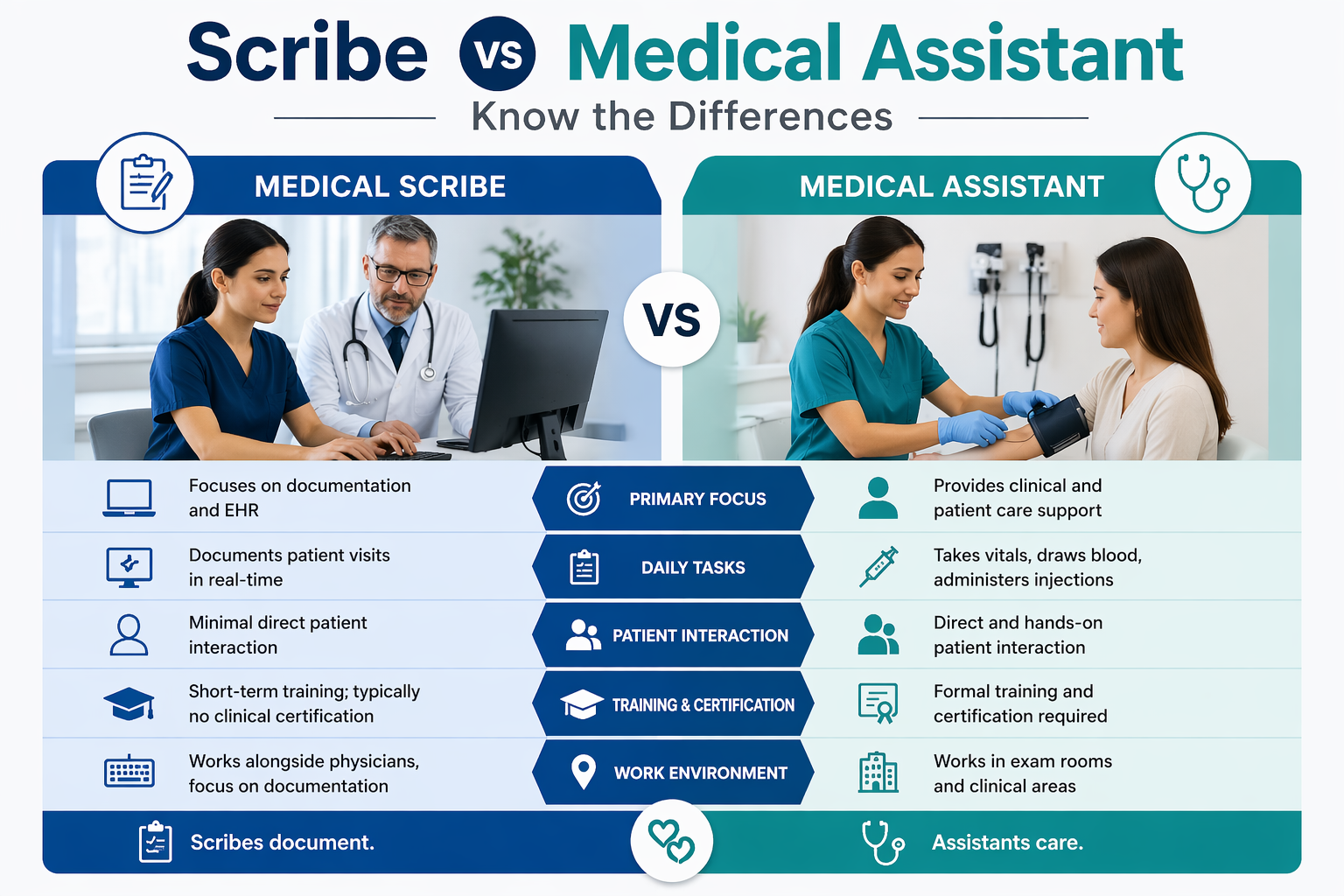
A scribe vs medical assistant comparison shows that scribes focus on documentation, while assistants provide clinical and patient care support.
Many people confuse these two roles, asking about the scribe vs medical assistant differences. While both support doctors, their daily tasks and training are completely distinct. Understanding this distinction is vital for both hiring managers and aspiring healthcare workers.
A medical assistant is a clinical worker who can perform hands-on patient tasks. They take vital signs, draw blood, administer injections, and prepare patients for examinations. Most states require medical assistants to complete formal training programs or earn specific certifications.
Conversely, a medical scribe handles zero clinical or hands-on tasks. They focus solely on documentation, data entry, and administrative workflow management. Because of this, scribes generally do not need the same level of formal clinical certification as medical assistants.
|
Feature |
Medical Scribe |
Medical Assistant |
|
Role Focus |
Documentation |
Clinical + Admin |
|
Patient Interaction |
Minimal |
Direct |
|
Tasks |
Note-taking, EHR |
Vitals, injections |
|
Training |
Short-term |
Formal certification |
Further Reading: How Long Does It Take to Become a Medical Assistant
How Medical Scribes Enhance Physician Efficiency and Patient Care
Burnout among healthcare providers is reaching record highs across the globe. Utilizing medical scribes for physicians is one of the most effective ways to combat this epidemic. Let's explore the massive advantages that a dedicated documentation assistant brings to a medical practice.
-
First and foremost, they drastically reduce the time doctors spend on data entry. Studies show that having a scribe can save a physician up to two hours of administrative work every day. This directly translates to less stress and a much lower risk of professional burnout.
-
Furthermore, scribes improve the overall quality of patient care. When a doctor does not have to type notes during a visit, they can make direct eye contact with the patient. This improves patient satisfaction and builds a much stronger therapeutic relationship.
-
Finally, hiring scribes actually increases clinical revenue and efficiency. Doctors can see more patients per day because their charting is completed in real-time. To learn more about optimizing clinical workflows, read our guide on.
The Industry Impact: Who Uses Medical Scribes the Most
While scribes started primarily in emergency rooms, they have spread to almost every corner of healthcare. Today, you can find them in large hospital networks and small family practices alike. They serve virtually any medical specialty where EHR documentation is required.
Emergency medicine still employs the highest number of medical scribes globally. The chaotic nature of the ER makes real-time documentation assistance an absolute necessity. However, specialties like orthopedics, cardiology, and oncology are rapidly catching up.
Additionally, the rise of telemedicine has created a massive demand for virtual scribing. These remote professionals listen to patient visits via secure audio links and complete charts from a distance. This flexibility has allowed even the smallest rural clinics to benefit from documentation support.
How to Become a Scribe for a Doctor: A Step-by-Step Guide
If you are asking how to be a scribe or how to become a scribe for a doctor, you are looking at a fantastic entry-level healthcare career. It requires no previous medical experience, making it perfect for students taking a gap year. Here is a clear, step-by-step path to landing your first scribing job.
-
Meet the basic requirements. You generally need a high school diploma, strong typing skills (usually 60+ WPM), and a basic understanding of medical terminology.
-
Apply to a professional scribe company or directly to local clinics. Many large national companies hire and train thousands of scribes every year.
-
Complete the required training. Most employers provide rigorous paid training covering EHR software, medical terminology, and documentation standards.
-
Pass the final competency assessments. You will likely need to pass a typing and medical terminology test before being placed with a physician.
-
Gain hands-on experience on the clinic floor. Once placed, you will work closely with a mentor scribe before flying solo with your assigned provider.
For those looking to accelerate their healthcare careers, gaining this type of clinical exposure is unmatched. Many former scribes report that the experience made their first year of medical school much easier. You can find excellent external resources and training modules at the American College of Medical Scribe Specialists.
Virtual vs. In-Person Medical Scribes: Which is Better?
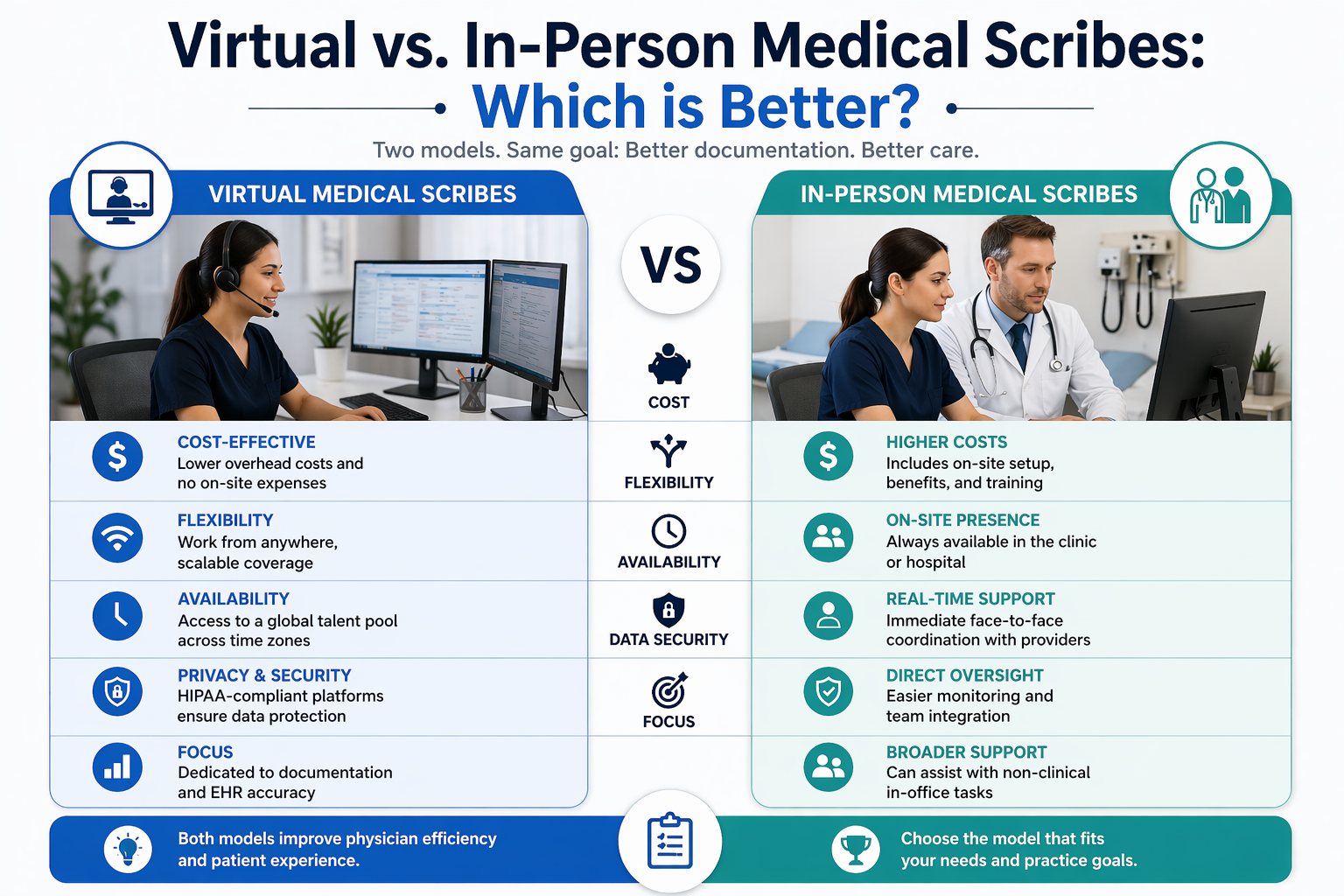
As technology improves, healthcare providers now have the option to choose between virtual and in-person scribes. Both options offer distinct advantages depending on the specific needs of the practice. Understanding these differences can help you make the right choice for your clinic.
In-person scribes offer a high level of personalization and direct workflow assistance. They are physically present in the room, making it easy for the doctor to communicate non-verbally. They can also perform light administrative tasks like printing discharge paperwork or guiding patients to the checkout desk.
On the other hand, virtual scribes offer incredible flexibility and reduced overhead costs. They connect via secure audio or video links and can work from anywhere in the world. This is an ideal solution for remote clinics or providers who prefer not to have an extra person in the exam room.
Challenges Faced by Medical Scribes
Being a medical scribe is not just about typing fast; it requires massive mental energy. Scribes must maintain intense focus for hours on end, often in high-stress environments. They need to understand complex medical conversations and accurately translate them into written form.
Another challenge involves managing relationships with different healthcare providers. Every doctor has a unique style of communicating and specific preferences for how charts are written. A successful scribe must be highly adaptable and learn to anticipate the needs of each individual doctor.
Finally, the risk of data entry errors is always present when documenting fast-paced encounters. A single misinterpreted word can change the clinical meaning of a note. Therefore, scribes must possess an extreme attention to detail and always double-check their work before submission.
The Future of Scribing: Will AI Replace Humans?
Artificial intelligence is making massive leaps forward in the field of medical documentation. Ambient AI scribes can now listen to a conversation and automatically generate a clinical note. This has led many to question the long-term viability of the human scribe profession.
While AI tools are incredibly impressive, they still lack the human touch and critical thinking skills. AI cannot interpret complex non-verbal cues or understand the nuances of a doctor's specific workflow. Furthermore, AI cannot assist with retrieving physical documents or coordinating care tasks.
The most likely future is a hybrid model where humans and AI work together. AI will generate the initial draft of the note, and the human scribe will refine and finalize it. This will make human scribes even more efficient and indispensable in the modern clinical environment.
Conclusion
Understanding what a medical scribe reveals just how much healthcare is evolving to meet modern challenges. Whether you are a provider looking to reclaim your time or a student seeking clinical experience, scribing offers massive value. By bridging the gap between human care and digital documentation, scribes are transforming the medical landscape.
Are you ready to eliminate EHR burnout and maximize your clinic's daily efficiency? Contact our team today to learn how our professional medical scribing services can transform your practice.